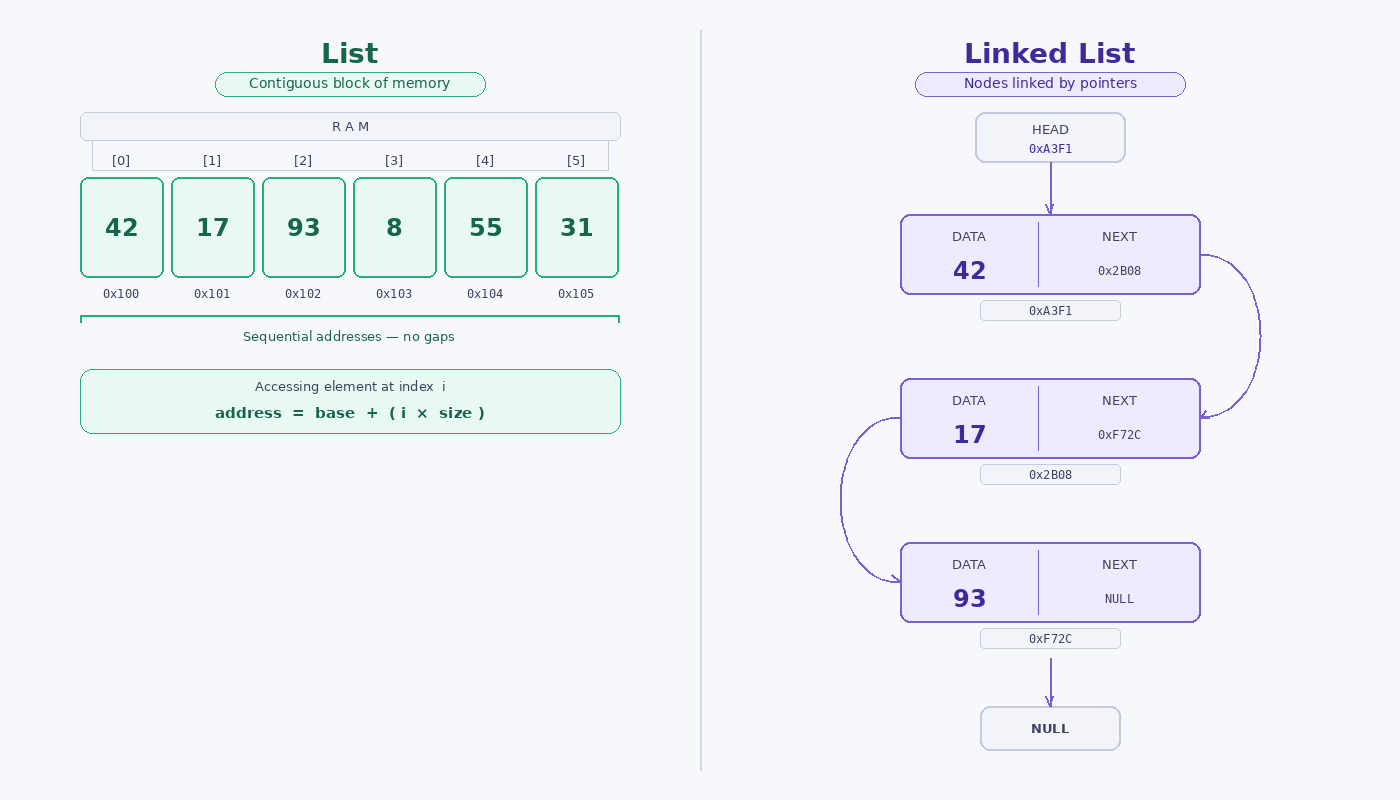
Python’s built-in list and a linked list both store sequences of elements, but they work very differently under the hood. A Python list uses a contiguous array in memory, giving it instant access by index. A linked list chains individual nodes with pointers, making insertions and deletions at the front virtually free. This guide walks through every common operation side by side — with visuals, code, and Big-O — so you can see exactly where each one wins and why.
Python has no built-in linked list
Before we start, one important thing: Python does not have a built-in linked list. You have to build it yourself from two small classes.
Node — the individual box that holds a value and a pointer to the next node:
1
2
3
4
|
class Node:
def __init__(self, val):
self.val = val
self.next = None # pointer to next node, starts as nothing
|
LinkedList — manages the chain of nodes. Here we only show append to keep it simple — the remaining methods (pop, prepend, pop_first, insert, remove, get, find) are each explained in their own section below.
1
2
3
4
5
6
7
8
9
10
11
12
13
14
15
16
17
18
19
20
21
|
class LinkedList:
def __init__(self):
self.head = None
self.tail = None
def append(self, val):
new_node = Node(val) # create a new node box
if self.tail:
self.tail.next = new_node # point old tail → new node
else:
self.head = new_node # first node is also the head
self.tail = new_node # update tail to new node
# pop, prepend, pop_first, insert, remove, get, find
# → defined in sections below
ll = LinkedList()
ll.append(42)
ll.append(17)
ll.append(93)
# 42 → 17 → 93 → None
|
So the full picture is:
-
Node — the individual box (data + next pointer). You write this yourself.
-
LinkedList — manages the chain of nodes. You write this yourself. Each operation is covered step by step in the sections that follow.
If you don’t want to build one from scratch, collections.deque is Python’s built-in doubly linked list under the hood. It gives you O(1) append and pop from both ends without writing any node classes.
Append — both O(1)
Python list reserves extra capacity at the back, so it just places the new element at the end directly.
1
2
|
a = [10, 20, 30]
a.append(40)
|
1
2
|
Before: [10][20][30][ ][ ] ← spare capacity at back
After: [10][20][30][40][ ] ← placed directly, no shifting
|
Linked list just wires a new node at the tail.
1
2
3
4
5
6
7
8
9
|
Before: head
↓
[10] → [20] → [30] → None
After: head
↓
[10] → [20] → [30] → [40] → None
↑
new node wired in
|
1
2
3
4
5
6
7
|
def append(self, val):
new_node = Node(val)
if self.tail:
self.tail.next = new_node # O(1) — point old tail → new node
else:
self.head = new_node # first node is also the head
self.tail = new_node # update tail to new node
|
Pop from end — Python list wins O(1) vs O(n)
Python list knows the last index instantly from its stored length. Removes it directly.
1
2
|
a = [10, 20, 30, 40]
a.pop()
|
1
2
3
4
|
Before: [10][20][30][40]
↑
length=4, so last index is 3. Remove directly.
After: [10][20][30]
|
Linked list has no index — must walk the entire chain to find the second-to-last node, then cut.
1
2
3
4
5
6
7
8
9
10
|
Before: head
↓
[10] → [20] → [30] → [40] → None
walk...walk...walk...found second-to-last!
After: head
↓
[10] → [20] → [30] → None
↑
cut here, [40] is gone
|
1
2
3
4
5
6
7
8
9
10
11
12
13
14
|
def pop(self):
if not self.head:
return None
if not self.head.next: # single node
val = self.head.val
self.head = self.tail = None
return val
cur = self.head
while cur.next.next: # O(n) — walk to second-to-last
cur = cur.next
val = cur.next.val
cur.next = None # cut the last node
self.tail = cur # update tail
return val
|
Prepend — Linked list wins O(1) vs O(n)
Python list must shift every element one step right to make room at index 0.
1
2
|
a = [10, 20, 30, 40]
a.insert(0, 99)
|
1
2
3
4
5
6
7
8
|
Before: [10][20][30][40]
Step 1 — shift everything right to make room:
[ ][10][20][30][40]
↑ ↑ ↑ ↑ each element moved one step
Step 2 — place 99 at index 0:
[99][10][20][30][40]
|
1 million elements = 1 million shifts. O(n).
Linked list just points the new node at the old head. Done in one step.
1
2
3
4
5
6
7
8
9
|
Before: head
↓
[10] → [20] → [30] → [40]
After: head
↓
[99] → [10] → [20] → [30] → [40]
↑
new node, just rewired
|
1
2
3
4
5
6
7
|
def prepend(self, val):
new_node = Node(val)
if self.head:
new_node.next = self.head # O(1) — point new node → old head
else:
self.tail = new_node # empty list, new node is also the tail
self.head = new_node # update head to new node
|
Pop first — Linked list wins O(1) vs O(n)
Python list removes index 0 then shifts every remaining element one step left to fill the gap.
1
2
|
a = [10, 20, 30, 40]
a.pop(0)
|
1
2
3
4
5
6
7
8
|
Before: [10][20][30][40]
Step 1 — remove 10:
[ ][20][30][40]
Step 2 — shift everything left to fill the gap:
[20][30][40][ ]
↑ ↑ ↑ each element moved one step
|
1 million elements = 1 million shifts. O(n).
Linked list just moves the head pointer forward. Nothing shifts.
1
2
3
4
5
6
7
8
9
|
Before: head
↓
[10] → [20] → [30] → [40]
After: head
↓
[10] [20] → [30] → [40]
↑
gone, head just moves forward
|
1
2
3
4
5
6
7
8
|
def pop_first(self):
if not self.head:
return None
val = self.head.val
self.head = self.head.next # O(1) — just move the pointer
if not self.head: # list is now empty
self.tail = None
return val
|
Insert middle — both O(n)
Both must walk to find the position first. Python list then also shifts elements to make room.
1
2
|
a = [10, 20, 30, 40]
a.insert(2, 99)
|
1
2
3
4
5
6
7
8
9
|
Step 1 — walk to index 2:
[10][20][30][40]
↑ found it
Step 2 — shift everything right from index 2:
[10][20][ ][30][40]
Step 3 — place 99:
[10][20][99][30][40]
|
Linked list still has to walk to find the position, but then just rewires — no shifting.
1
2
3
4
5
6
7
8
9
10
11
|
Before: head
↓
[10] → [20] → [30] → [40]
↑
walk to node before index 2
After: head
↓
[10] → [20] → [99] → [30] → [40]
↑
inserted, no shifting
|
1
2
3
4
5
6
7
8
9
10
11
12
|
def insert(self, index, val):
if index == 0: # insert at head
self.prepend(val)
return
cur = self.head
for _ in range(index - 1): # O(n) — walk to position
cur = cur.next
new_node = Node(val)
new_node.next = cur.next # O(1) — rewire
cur.next = new_node
if cur is self.tail: # inserted at the end
self.tail = new_node
|
Remove by value — both O(n)
Both must scan through elements to find the value. No shortcut for either.
1
2
|
a = [10, 20, 30, 40]
a.remove(30)
|
1
2
3
4
5
|
Before: [10][20][30][40]
↑
scan left to right... found 30. Remove, shift left.
After: [10][20][40]
|
Linked list scans too, but just cuts the node — no shifting.
1
2
3
4
5
6
7
8
9
|
Before: head
↓
[10] → [20] → [30] → [40]
↑
found 30, rewire [20] to skip [30]
After: head
↓
[10] → [20] → [40]
|
1
2
3
4
5
6
7
8
9
10
11
12
13
14
15
16
|
def remove(self, val):
if not self.head:
return
if self.head.val == val: # remove head
self.head = self.head.next
if not self.head: # list is now empty
self.tail = None
return
cur = self.head
while cur.next: # O(n) — walk to find value
if cur.next.val == val:
if cur.next is self.tail: # removing the tail
self.tail = cur
cur.next = cur.next.next # O(1) — rewire
return
cur = cur.next
|
Lookup by index — Python list wins O(1) vs O(n)
Python list calculates the memory address directly using math. Instant.
1
2
|
a = [10, 20, 30, 40]
a[2] # → 30
|
1
2
3
|
address = base_address + (2 × element_size)
= 1000 + (2 × 8)
= 1016 → go there directly, get 30. Done. O(1)
|
Linked list has no index — must hop node by node from the head.
1
2
3
4
5
6
7
8
9
|
Want index 2:
head
↓
[10] → hop
[20] → hop
[30] → arrived at index 2. Done.
Want index 1000? Make 1000 hops. O(n).
|
1
2
3
4
5
|
def get(self, index):
cur = self.head
for _ in range(index): # O(n) — no shortcut
cur = cur.next
return cur.val
|
Lookup by value — both O(n)
Both must scan every element until the value is found. No shortcut for either.
1
2
|
a = [10, 20, 30, 40]
30 in a # scans left to right until found
|
1
2
3
|
Before: [10][20][30][40]
↑
not it → not it → found 30! O(n) in worst case.
|
Linked list does the same scan, just following pointers.
1
2
3
4
5
|
head
↓
[10] → not it
[20] → not it
[30] → found! O(n) in worst case.
|
1
2
3
4
5
6
|
def find(self, val):
cur = self.head
while cur: # O(n) — scan every node
if cur.val == val:
return cur
cur = cur.next
|
Full picture
| Operation |
Linked List |
Python List |
| Append |
O(1) ⚡ |
O(1) ⚡ |
| Pop (end) |
O(n) 🐢 |
O(1) ⚡ |
| Prepend |
O(1) ⚡ |
O(n) 🐢 |
| Pop First |
O(1) ⚡ |
O(n) 🐢 |
| Insert (middle) |
O(n) 🐢 |
O(n) 🐢 |
| Remove (by value) |
O(n) 🐢 |
O(n) 🐢 |
| Lookup by Index |
O(n) 🐢 |
O(1) ⚡ |
| Lookup by Value |
O(n) 🐢 |
O(n) 🐢 |
Linked list wins at the front. Python list wins at the back and by index. If you need both, use collections.deque.